 Wimpy wanted to let visually impaired people know that
they offered braille menus in all of their restaurants. To spread the
word we built braille burgers that blind people could actually read.
With the help of skilled chefs we took sesame seeds and meticulously
placed them on burger buns so that the seeds formed braille.
Wimpy wanted to let visually impaired people know that
they offered braille menus in all of their restaurants. To spread the
word we built braille burgers that blind people could actually read.
With the help of skilled chefs we took sesame seeds and meticulously
placed them on burger buns so that the seeds formed braille.
Saturday, 15 September 2012
Wimpy Braille Burgers
Wimpy wanted to let visually impaired people know that
they offered braille menus in all of their restaurants. To spread the
word we built braille burgers that blind people could actually read.
With the help of skilled chefs we took sesame seeds and meticulously
placed them on burger buns so that the seeds formed braille.
Tackle Design Inc.
 With clients ranging from major research universities to artists, from
industrialists to inventors, Tackle Design Inc is unified by the pursuit of elegant solutions and a commitment to quality workmanship.
With clients ranging from major research universities to artists, from
industrialists to inventors, Tackle Design Inc is unified by the pursuit of elegant solutions and a commitment to quality workmanship.
Our areas of accomplishment range from solutions for improving cardiovascular surgery to refinement of aerospace manufacturing processes to concept development and prototyping for consumer electronics devices.
Tools for Minimally Invasive Robotic Surgery (MIRS)


Robotic systems have become the state of the art in many types of
surgical procedures, allowing the surgeon to perform complex operations
through small, fast healing incisions. Tackle is a member of an
interdisciplinary team of NIH funded researchers at NCSU developing retraction and fixation tools
for MIRS procedures. Our involvement has included creativity training
for team members, concept development and prototyping work as well as
participation in surgical trials.
The Open Prosthetics Project


Tackle has launched The Open Prosthetics Project
to create useful and innovative prosthetic devices and fully publish
our designs for anyone to use, customize, or improve on. By
substituting public good for profits, we believe that we can generate
far more societal benefit than if we commercialized and sold our ideas.
We are currently developing several novel prosthetic concepts and
seeking funding from donations and grants.


Becky Pilditch
 |
| Experiment 1: Wooden Hand |
Super Prosthetics Project is about exploring
armwear as an object of empowerment, choice and identity. The purpose
was to conduct a series of creative experiments to challenge current
ideas of prosthetics and explore what a wearer might choose to create in
that space if he or she could have any functionality or aesthetic.
The project has been conducted at the Royal
Collage of Art in London by Becky Pilditch and with the help of Holly
Franklin. It has been developed in conversation with individuals who
wear and make prosthetics limbs and the blog has been created to make
the process visible for those who wish to share ideas and continue
dialogue on the subject.
Each experiment took the form of an object,
created for Holly to wear and critique in a public space. The final
result was a repertoire of objects that explored the relationship
between Holly, her hands and her peers, for the purposes of positive
social interaction.
 |
| Experiment 2: Ceramic Hand |
 |
| Experiment 3: Bejewelled Hook; rhinestone and silver |
 |
| Experiment 4: Leather Palm |
 |
| Experiment 5: Glass hand; resin |
 |
| Experiment 6: Transparent Fingertips; cherry wood and resin |
 |
| Experiment 7: Hand Puppetry; wood, nylon and steel |
 |
| Experiment 8: Gestural Hand Series; maple, balsa, nylon and steel (final hand) |
Jonathan Kuniholm
 |
| Jonathan Kuniholm, an Iraq veteran who lost his arm in 2005, is one of 300 engineers working on DARPA’s Revolutionizing Prosthetics 2009 program, which was created to solve the thorny interdisciplinary problems that stand in the way of creating truly functional prosthetic arms. |
An international team led by The Johns Hopkins University Applied Physics Laboratory (APL) in Laurel, Md., has developed a prototype of
the first fully integrated prosthetic arm that can be controlled
naturally, provide sensory feedback and allows for eight degrees of
freedom—a level of control far beyond the current state of the art for
prosthetic limbs. Proto 1, developed for the Defense Advanced Research
Projects Agency (DARPA) Revolutionizing Prosthetics Program, is a
complete limb system that also includes a virtual environment used for
patient training, clinical configuration, and to record limb movements
and control signals during clinical investigations.
 |
Jesse Sullivan, a former high-power lineman, lost
both arms in 2001 after being electrocuted on the job. In these three
photos, he demonstrates the capabilities of the Proto 1 prosthetic arm
system during clinical tests at the Rehabilitation Institute of Chicago.
|


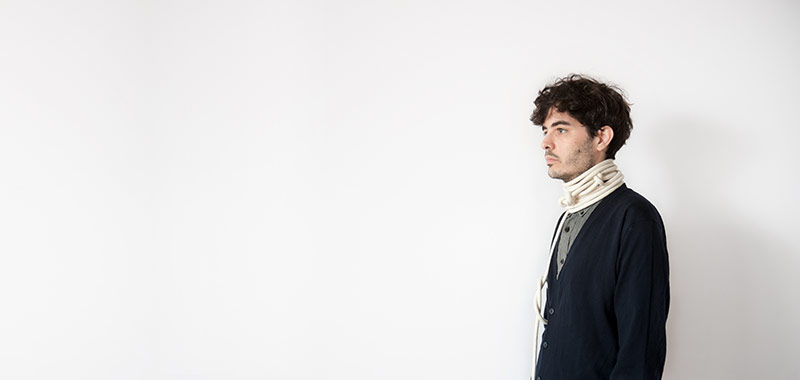
Pilar Cotter
Musings about transit in communication.
I understand transit as the distance allowed to an emitter between
thought and verb, this fictitious hallway where thoughts are filtered,
will always be affected by the emotional context enveloping the emitter.
I suppose there are no fixed formulas to activate or facilitate the
sorting of this series of emotional complexities which will give rise to
either contention or fluidity. Words such as baring or untying come to
my head from the collective imaginarium. Words directly related to
comunication. Baring implies an act of transparency, untying, the
decision to overcome any conflict to transmit what one wishes.
This is how we tie and untie, show and hide, this is how we retain and let go.
 | ||
| Broochs. Porcelain, silver. 11×8 cm, 7×8 cm. 2012. |
 |
| ins. Porcelain, silver. 11×0,5 cm, 7×1 cm. 2012 |
 |
| Broochs. Porcelain, silver. 13×7 cm. 2012. |
Friday, 14 September 2012


Subscribe to:
Posts (Atom)